China Top 10 TPLO Plate Dog Suppliers?
Choosing among China’s top 10 TPLO plate dog suppliers requires more than comparing catalog prices. A reliable supplier should demonstrate orthopedic manufacturing experience, consistent plate geometry, and clear material documentation. Surgeons also need practical details, including locking-screw compatibility, hole accuracy, surface finish, and available sizes for different canine tibias.
Dr. Barclay Slocum, the veterinary surgeon associated with TPLO development, stated, “The goal of TPLO surgery is to neutralize cranial tibial thrust.” That principle still matters when evaluating every TPLO Plate Dog system. A plate may look polished in photographs, yet its contour, screw engagement, and intraoperative handling deserve closer attention. Ask for material certificates, batch traceability, dimensional inspection records, and evidence of quality-system controls. Do not rely on marketing language alone.
Good suppliers should provide technical drawings, surgical instructions, and responsive communication after delivery. Sample inspection can reveal uneven edges, poor polishing, or inconsistent screw threads. These details seem minor. They are not.
This guide reviews ten Chinese suppliers through product range, manufacturing capability, customization support, export experience, and documentation quality. The ranking is not a surgical recommendation. It is a purchasing reference. Supplier information can change, and some claims require direct verification. That limitation should be acknowledged.
Veterinary hospitals should consult qualified orthopedic surgeons before selecting implants. A lower price may reduce purchasing costs, but it cannot compensate for uncertain fit or incomplete traceability. The strongest supplier is not always the largest. It is the one that combines repeatable production, transparent evidence, and dependable clinical support.
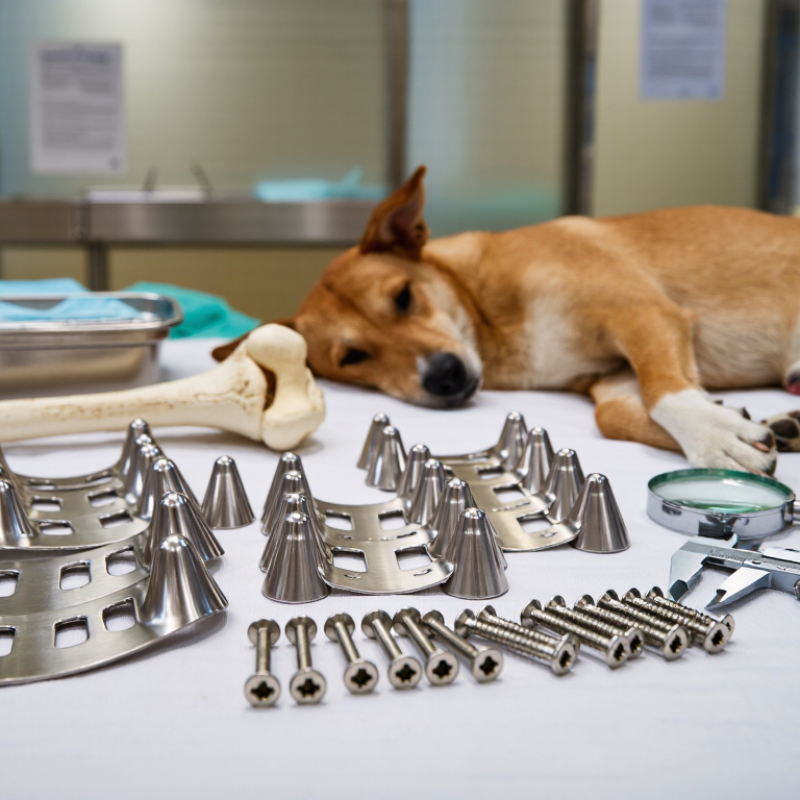
What Are TPLO Plates and Why Do Dogs Need Them?
What Are TPLO Plates and Why Do Dogs Need Them?
A TPLO plate is a surgical implant used during tibial plateau leveling osteotomy. This procedure treats cranial cruciate ligament disease, one of the most common orthopedic problems in dogs, according to the American College of Veterinary Surgeons. The surgeon reshapes the upper tibia and secures the bone with a contoured plate and screws. This changes joint mechanics. The knee can then remain stable during weight bearing, even when the ligament is damaged.
Dogs may need TPLO surgery when lameness, pain, instability, or a partial ligament tear limits normal movement. Larger, active dogs often place greater stress on the knee. Published veterinary reviews commonly report favorable functional outcomes in about 85–95% of cases after TPLO, although recovery depends on weight, age, meniscal injury, and rehabilitation. The evidence is useful, but not perfect.
A plate is not a cure by itself. Veterinary surgeons assess screw positioning, plate strength, bone quality, and infection risk before choosing an implant. Supplier comparisons should examine material standards, fatigue testing, manufacturing traceability, and instrument compatibility. The American Veterinary Medical Association emphasizes professional diagnosis and informed treatment decisions. A “top ten” supplier list can guide research, but it cannot replace clinical judgment. Even experienced teams sometimes revise their expectations after imaging or surgery. That uncertainty deserves honest discussion.
How to Evaluate Chinese TPLO Plate Suppliers
How to Evaluate Chinese TPLO Plate Suppliers
China’s expanding veterinary-device sector offers many TPLO plate suppliers, but price alone reveals little. The American Pet Products Association reported US pet spending of $147 billion in 2023, showing strong demand for dependable surgical care. That demand deserves careful sourcing.
Request an ISO 13485 certificate, manufacturing scope, and recent audit records. Check whether the certificate covers orthopedic implants, not only general instruments. Ask for material certificates showing titanium or implant-grade stainless steel composition. Review plate thickness, hole geometry, surface finish, and dimensional tolerances. A plate should fit consistently on the bench, not only in a product photograph.
Ask for fatigue-test methods, load limits, corrosion testing, and batch-level inspection reports. Suppliers should explain machining, polishing, cleaning, packaging, and traceability. Confirm that each lot carries a usable number linked to raw materials and inspection results. Clinical evidence matters. Request anonymized case data, complication rates, follow-up periods, and surgeon feedback. Marketing claims are not evidence.
Small details matter.
Evaluate communication, too. Can the engineering team answer questions with drawings and test data? Can they provide samples for independent veterinary review? A low quotation may exclude packaging validation, testing, or after-sales support. I have seen supplier comparisons fail because buyers checked certificates but ignored plate fit and screw compatibility. That mistake is easy to repeat. A practical audit should combine documents, sample inspection, production observation, and transparent discussion of known limitations.
China’s Top 10 TPLO Plate Dog Suppliers
China’s Top 10 TPLO Plate Dog Suppliers
China’s top 10 TPLO plate dog suppliers should be assessed through clinical evidence, not catalogue size. Grand View Research estimated the global veterinary surgical instruments market at over US$1.5 billion in 2023, with continued growth through 2030. This expansion increases supplier choices, but it also makes verification more important. A dependable supplier should provide implant-grade stainless steel or titanium, traceable material certificates, dimensional drawings, and documented quality controls. Small details matter. Plate holes must align accurately with compatible screws. Edges should feel smooth under inspection, not sharp or irregular.
Experienced buyers should compare the ten suppliers by production capability, not advertising language. Useful checks include batch sampling, sterilization guidance, corrosion testing, packaging integrity, and response time for surgical questions. ISO 13485-based procedures can indicate mature medical-device management, although certification alone does not prove clinical performance. Veterinary orthopedic literature also emphasizes accurate reduction, stable fixation, and appropriate postoperative monitoring after TPLO surgery. Suppliers should therefore explain plate thickness, locking options, screw sizes, and recommended radiographic checks. Ask for real inspection records.
Some suppliers may offer lower prices, but hidden costs can appear through inconsistent holes, delayed revisions, or incomplete documentation. That risk is easy to underestimate. I would also review surgeon feedback from several clinics, not one enthusiastic testimonial. No supplier is perfect. The strongest candidates usually communicate limitations clearly, accept independent testing, and improve after receiving technical criticism. Market ranking should remain adjustable as evidence changes.
China Top 10 TPLO Plate Dog Suppliers
This non-brand reference chart shows common metric locking-screw diameter options used in TPLO and other veterinary orthopedic fixation systems. Actual product availability, plate compatibility, sterilization status, and regulatory documentation should be verified directly with each supplier.
Comparing Materials, Designs, Certifications, and Production Capacity
China Top 10 TPLO Plate Dog Suppliers? Comparing Materials, Designs, Certifications, and Production Capacity
When comparing China’s top ten TPLO plate suppliers, material selection deserves close attention. Titanium alloy offers low weight, strong corrosion resistance, and useful imaging clarity. Stainless steel can provide dependable strength at a lower purchase cost. However, alloy grade alone proves little. Ask for composition reports, fatigue-test results, and traceable batch records. A 2024 Grand View Research report forecasts steady growth in the global veterinary orthopedic market, with demand increasingly linked to durable, minimally invasive implants.
Design quality is equally practical. Check left and right anatomical versions, plate thickness, hole spacing, locking compatibility, and contour accuracy. A plate should sit closely against the tibia without excessive bending. Small errors matter. Compare CNC tolerances, surface finishing, sterilization controls, and packaging integrity. Suppliers claiming ISO 13485 certification should provide a valid certificate and scope. ISO 10993 testing may support biological safety, but it does not automatically approve a finished TPLO system in every market. That assumption is risky.
Production capacity needs evidence, not impressive photographs. Request monthly output, equipment lists, inspection procedures, nonconformance rates, and typical lead times. The ISO Survey reports more than one million ISO 9001 certificates worldwide, yet certification alone cannot confirm orthopedic expertise. Independent audits, surgeon feedback, and sample evaluation remain valuable. I would also question unusually low prices. They may reflect efficient manufacturing, or weaker validation. Only documented data can separate the two.
How to Choose the Right TPLO Plate Supplier for Your Practice
China Top 10 TPLO Plate Dog Suppliers?
How to Choose the Right TPLO Plate Supplier for Your Practice
A supplier ranking can attract attention, but it cannot prove surgical suitability. Grand View Research’s 2024 Veterinary Orthopedic Implants report forecasts market growth above 8% annually through 2030. That growth also increases supplier choices and quality risks. Begin with traceable material certificates, dimensional drawings, and batch inspection records. Ask whether the plate uses implant-grade stainless steel or titanium. Confirm the standard, not just the sales description.
Fit matters clinically. Request left and right plate samples, screw compatibility charts, and radiographic templates. Place a sample on a bone model before ordering bulk stock. Check contour accuracy around the tibial plateau. Small gaps can complicate compression and increase intraoperative adjustments. The American College of Veterinary Surgeons describes cranial cruciate ligament disease as a common canine orthopedic problem. Therefore, repeatable sizing is more valuable than attractive packaging.
Do not skip supplier audits. Review ISO 13485 certification, sterilization validation, complaint handling, and recall procedures. Ask for manufacturing photographs and recent third-party test reports. Verify that certificates match the actual factory address. That detail is often overlooked. A 2023 veterinary device market analysis by MarketsandMarkets also links orthopedic implant demand with stricter quality expectations. Still, market reports are not clinical evidence. Request surgeon feedback from comparable cases, while recognizing that informal testimonials can be incomplete. A dependable supplier should answer technical questions clearly, provide controlled documentation, and accept reasonable pre-shipment inspection.