Pawsome-Specializing in vet health products since 2015
China has become a major sourcing destination for Skin Hook instruments, supported by precision machining, stainless-steel production, and export experience. Yet “top supplier” should mean more than a polished catalogue. It should reflect consistent quality, traceability, and dependable communication.
Dr. Lena Morris, a surgical-instrument quality consultant, states, “A Skin Hook must feel controlled in the surgeon’s hand before it can be trusted in practice.” Her observation highlights a practical truth. Small details matter. The handle should provide a secure grip without sharp edges. The hook tip should be accurately formed, smooth, and properly aligned. Surgical-grade stainless steel should resist corrosion after repeated cleaning and sterilization.
Experienced buyers usually inspect factory records, material certificates, inspection reports, and packaging methods. They may also request samples before placing a larger order. A reliable China Skin Hook manufacturer should explain its production process clearly. It should identify quality checkpoints, tolerance standards, and applicable medical-device requirements. ISO 13485 certification can support confidence, but it does not replace product evaluation.
There is no perfect supplier.
A catalogue image cannot prove performance. Even a strong manufacturer may show occasional variation between batches. That weakness deserves honest discussion, not marketing language. Buyers should compare hook size, tip design, surface finish, customization options, lead time, and after-sales support.
The right Skin Hook supplier combines manufacturing skill with transparent evidence. Careful communication remains essential. In this market, trust is built through samples, records, and repeatable results—not promises alone.
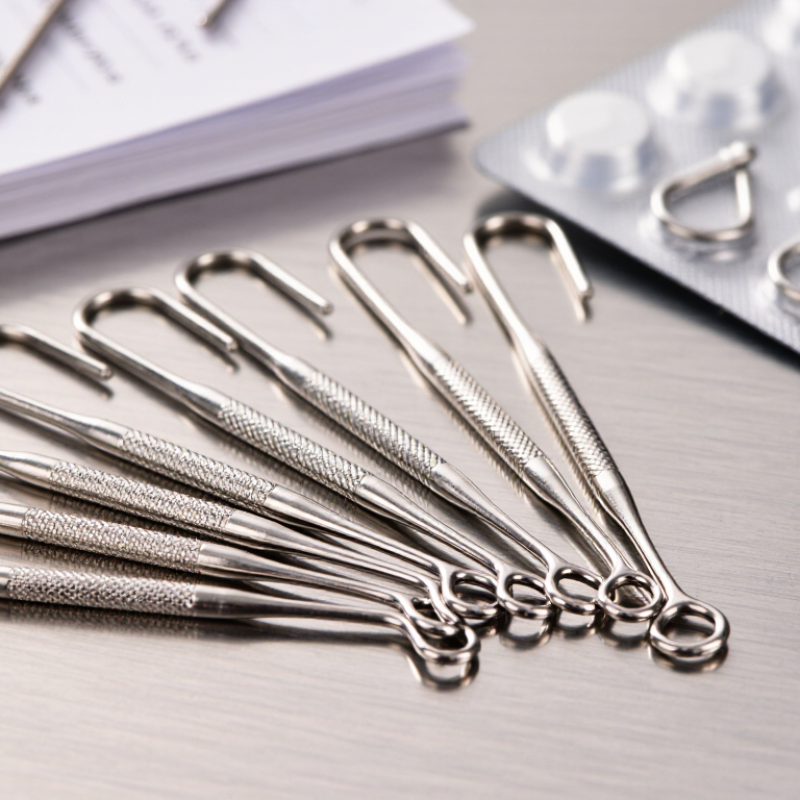
A skin hook is a small surgical instrument with one or more fine, pointed prongs. Its handle gives a clinician controlled contact with the skin or wound edge. Unlike forceps, it usually lifts tissue without gripping a broad surface. The design may be single-ended, double-ended, or angled for improved access.
Skin hooks are commonly used in dermatology, plastic surgery, ophthalmic procedures, and wound closure. A clinician may use one to retract a skin edge while placing sutures, examining a small lesion, or positioning a graft. The hook should provide steady exposure with minimal pressure. Small details matter. A sharp tip can improve control, but excessive force may cause unnecessary tissue trauma.
From a manufacturing and supply perspective, reliable instruments require accurate dimensions, balanced handles, smooth surfaces, and properly aligned tips. Stainless steel is widely selected for strength and corrosion resistance. Suppliers should provide clear specifications, inspection records, packaging information, and guidance on cleaning or sterilization compatibility. These details support safer clinical workflows.
A small hook is not automatically gentle. Technique still matters. Specifications alone cannot replace practical evaluation by trained users. In my view, manufacturers should test handling comfort, tip consistency, and repeated sterilization performance instead of focusing only on appearance. That standard is easy to overlook.
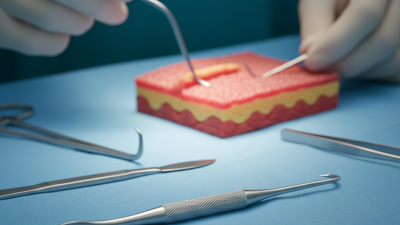
A skin hook is a small surgical retractor used to gently grasp and retract skin or soft tissue, helping maintain visibility during procedures. Common configurations include single-prong, double-prong, and four-prong designs.
The chart compares common skin hook configurations by the number of prongs used to engage tissue. Single- and double-prong hooks are frequently selected for controlled, localized retraction, while four-prong designs can provide broader superficial tissue engagement.
A reliable skin hook manufacturer starts with practical surgical needs, not attractive catalog photos. The hook should provide stable tissue control without excessive pressure. Its tips need consistent geometry, smooth edges, and a clean finish. A good hook feels controlled. Common materials include surgical stainless steel, selected for strength, corrosion resistance, and repeated sterilization. Experienced engineers should check the handle balance, shaft alignment, and grip comfort during actual handling.
Quality control must continue beyond visual inspection. A dependable supplier should maintain documented material records, dimensional checks, surface inspections, and batch traceability. These records help buyers identify when and where each instrument was produced. Packaging also matters. Each hook should be protected from scratches, contamination, and moisture before shipment. Clear product specifications make communication easier, especially when discussing tip length, hook depth, handle style, or custom requirements.
Manufacturing experience is useful, but it does not remove the need for verification. No production line is flawless. A responsible manufacturer admits this and explains how nonconforming pieces are isolated. Sample testing should include repeated cleaning and sterilization cycles when applicable. Suppliers should answer technical questions directly, rather than promise everything is perfect. That honesty builds trust. It also reveals whether their inspection process works outside a sales conversation. Calibration records, inspection reports, and responsive after-sales communication can distinguish a reliable partner from a low-cost reseller.
Designing and manufacturing skin hooks in China requires more than shaping metal into sharp points. Engineers begin with the surgical purpose, tissue contact, handle balance, and required working depth. A hook may be single-pronged or multi-pronged, depending on the procedure. Small details matter.
Common production routes include CNC machining, precision stamping, and controlled forming. Medical-grade stainless steel is selected for strength, corrosion resistance, and repeated sterilization. After forming, technicians remove burrs and polish contact surfaces. One rough edge can damage tissue or weaken cleaning results. It should never pass inspection.
Reliable factories use drawings, samples, and measurable tolerances throughout production. Coordinate measuring equipment checks dimensions, while visual inspection examines tips, joints, and surface finish. Batch records support material traceability. Packaging must also protect the points from bending during transport. Simple protection is often overlooked.
The process is not perfect. A drawing may miss the surgeon’s preferred grip, or a polished surface may reduce tactile feedback. Experienced suppliers collect user comments, review failed samples, and adjust tooling carefully. Prototype testing can reveal problems that computer models cannot show. Final production should follow documented quality procedures and applicable medical-device requirements, with inspection records available for review.
| Design and Manufacturing Dimension | Typical Specification or Practice | Purpose in Skin Hook Production | Common Quality Check |
|---|---|---|---|
| Instrument Type | Single-prong, double-prong, or multi-prong skin hook | Provides controlled tissue retraction during surgery | Visual inspection of prong alignment and overall symmetry |
| Common Material | Martensitic stainless steel grades commonly used for surgical instruments, such as 410, 420, or 440A, subject to the agreed specification | Balances corrosion resistance, strength, hardness, and manufacturability | Material certificate review and positive material identification when required |
| Overall Length | Typically about 120–220 mm, depending on the surgical application and handle design | Supports access to superficial, narrow, or deeper operative sites | Dimensional inspection using calibrated gauges or measuring equipment |
| Prong Configuration | Sharp or blunt tips; one to four prongs; straight, angled, or curved geometry | Allows the instrument to be matched to tissue handling requirements | Tip geometry, spacing, angle, and symmetry checked against drawings or samples |
| Handle Design | Flat, round, ring-style, or ergonomically contoured handle with a textured or satin grip | Improves control, tactile feedback, and handling during repeated use | Grip comfort, surface uniformity, and dimensional consistency assessment |
| Primary Forming Process | Cold forming, machining, or forging may be selected according to the instrument design and production volume | Creates the handle, shaft, and prong profile before finishing operations | Checks for cracks, deformation, incomplete forming, and dimensional variation |
| Machining and Shaping | CNC machining, grinding, milling, and precision tip forming are commonly used for repeatable geometry | Controls profile accuracy and produces consistent working ends | First-article inspection and in-process dimensional checks |
| Heat Treatment | Hardening and tempering may be applied to suitable stainless steel grades to achieve the specified mechanical properties | Improves strength, wear resistance, and resistance to permanent deformation | Hardness testing and review of heat-treatment records |
| Surface Finishing | Grinding, polishing, satin finishing, and electropolishing may be used according to the required surface condition | Removes burrs, improves cleanability, and provides the specified appearance | Inspection for burrs, scratches, pits, discoloration, and rough finishing |
| Passivation | Chemical passivation may be performed after machining and polishing; ASTM A967 is a commonly referenced passivation standard | Helps remove free iron and supports corrosion resistance of stainless steel surfaces | Process-record review and corrosion-resistance testing when specified |
| Cleaning and Ultrasonic Washing | Detergent cleaning, ultrasonic washing, rinsing, and controlled drying before final inspection | Removes abrasive residue, oil, metal particles, and processing contaminants | Visual cleanliness inspection and, where required, residue or particle testing |
| Functional Testing | Prong retention, alignment, handle integrity, and resistance to ordinary manual deflection are evaluated according to the product specification | Confirms that the hook performs reliably during intended handling | Functional inspection, visual examination, and documented sampling plans |
| Applicable Quality Framework | Manufacturing controls may be organized under ISO 13485, with product requirements defined by applicable medical-device regulations | Supports traceability, process control, corrective action, and consistent production | Audit records, batch records, inspection reports, and corrective-action documentation |
| Packaging | Protective individual packaging or tray packaging, with sterilization packaging used only when the product is supplied as sterile | Prevents scratching, contamination, and prong damage during storage and transport | Packaging integrity, labeling accuracy, and quantity verification |
| Customization Options | Length, prong count, tip style, curvature, handle profile, surface finish, marking, and packaging can be specified through approved technical drawings | Adapts the skin hook to surgical specialty, user preference, and market requirements | Drawing approval, prototype review, first-article inspection, and change-control records |
Note: Specifications shown are typical reference ranges and manufacturing practices. Final requirements should be confirmed through approved drawings, applicable regulations, and the intended use of the instrument.
Quality begins with evidence, not polished photographs. The World Health Organization reports more than two million medical device types across over 7,000 generic groups. Skin hooks require tighter control because small tip changes can affect handling, tissue contact, and visibility. A qualified China supplier should maintain ISO 13485 quality systems, documented risk controls under ISO 14971, and material records aligned with ISO 7153-1. These records should identify stainless steel grades, heat treatment, passivation, and surface finishing.
The ISO Survey 2022 recorded more than 26,000 ISO 13485 certificates worldwide. Certification helps, but it does not prove every production batch is consistent. Ask for dimensional inspection results, tip alignment checks, hardness data, and corrosion-resistance testing. For patient-contacting surfaces, review applicable biocompatibility evidence under ISO 10993. Packaging validation also matters. A clean hook can still fail if its pouch seal breaks during transport.
In practical supplier audits, I would inspect sample hooks under magnification. Look for burrs, uneven serrations, loose joints, or rough edges around the handle. The supplier should provide lot traceability from steel receipt to final inspection. Reusable instruments need clear cleaning and sterilization compatibility data. Some factories provide excellent samples but weaker routine control. That gap deserves attention. A stronger evaluation compares three production lots, not one attractive sample. Supplier communication should also include measurement tolerances, inspection frequency, nonconformance records, and corrective-action evidence.
Choosing a skin hook supplier requires more than comparing prices. Start with the instrument’s intended procedure, tissue handling needs, and expected frequency of use. Ask for drawings showing hook size, shaft length, tip angle, and handle dimensions. Small differences can affect grip, visibility, and control during delicate work.
Material evidence matters. Request the stated stainless-steel grade, surface-finish specifications, and corrosion-resistance test results. A dependable supplier should provide batch identification, inspection records, and clear packaging details. Confirm whether the instruments support your validated cleaning and sterilization process. Autoclave compatibility should never be assumed. It must be documented. Review the supplier’s quality system, manufacturing controls, and applicable regulatory documentation. Factory audits, production samples, and independent testing can reveal problems that photographs hide.
Communication is another practical test. Ask how the supplier handles dimensional changes, rejected samples, and delivery delays. Measure a sample yourself, including hook thickness and symmetry. A polished website proves little. A precise answer with supporting records proves more. The lowest quote may exclude inspection, packaging, or replacement arrangements. That makes comparison harder. No supplier is perfect, and even a careful evaluation can miss a weakness. Keep written specifications, approval samples, and traceability requirements before placing a larger order. Choose the partner that can explain each detail clearly, not merely promise fast production.