Pawsome-Specializing in vet health products since 2015
Buying Veterinary Implants is not a simple price comparison. It is a clinical decision involving anatomy, biomechanics, sterility, traceability, and long-term patient welfare. The American Pet Products Association reported that 86.9 million U.S. households owned a pet in its 2023–2024 National Pet Owners Survey. Its 2024 State of the Industry report also recorded $147 billion in U.S. pet spending during 2023. These figures suggest a growing demand for advanced veterinary care, but they do not guarantee better purchasing decisions. Details matter.
This guide presents 10 practical tips for evaluating Veterinary Implants with a licensed veterinary professional. It considers implant materials, sizing systems, manufacturing quality, documentation, supplier support, and compatibility with surgical instruments. Standards such as ISO 13485 for quality management and ISO 10993 for biological evaluation can provide useful reference points. However, certification alone is not the whole answer. Ask for batch information, sterilization guidance, testing records, and clear instructions for use. A cheaper plate may appear efficient until poor fit increases operating time or revision risk. That possibility deserves honest attention. Surgeons should also review published evidence and compare real clinical experience, not only marketing claims. The best choice may differ between a small terrier, a working dog, and an older cat. Good purchasing is careful, documented, and patient-centered. It leaves room for questions. And sometimes, reconsideration.
10 Tips for Buying Veterinary Implants
Define the Veterinary Implant’s Intended Clinical Purpose
Before comparing prices or materials, define exactly what the implant must accomplish. Is it stabilizing a fractured limb, replacing a damaged joint, closing a soft-tissue defect, or supporting dental repair? Each purpose creates different demands on strength, flexibility, placement, and healing time.
Describe the patient, too. A 3-kilogram cat and a 60-kilogram dog do not load an implant in the same way. Record the affected bone, expected activity level, age, tissue condition, and likely recovery period. A working dog may need greater fatigue resistance. An older animal may require gentler handling and closer imaging follow-up.
Be specific.
The surgical team should match the implant to the planned technique, not force the technique around an available product. Review dimensions, fixation points, instrument compatibility, imaging visibility, and removal requirements before purchase. Ask whether the implant can tolerate the expected forces throughout healing, including jumping, chewing, or sudden movement.
Clinical evidence matters. Request documented testing, material information, sterilization guidance, and traceability records from the supplier. Veterinary surgeons should assess these details with the animal’s diagnosis and anatomy in mind. Laboratory strength does not always predict real healing conditions. That is an easy mistake to make. Reassess the choice if imaging reveals poor bone quality, unexpected infection, or a change in the surgical plan. A useful decision may still need revision.
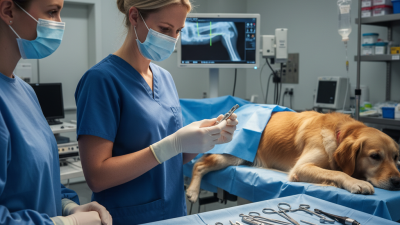
Implant selection should begin with the clinical objective. The chart compares common veterinary implant purposes by their primary design priority, using a qualitative clinical-planning scale from 1 (low) to 5 (very high).
The priorities reflect established veterinary applications: fracture fixation requires structural stability, joint replacement emphasizes articulation and motion, spinal stabilization focuses on protection of neural structures, arthrodesis requires rigid fusion, and dental implants require osseointegration and functional restoration.
Buying Veterinary Implants: Assess Material, Design, Size, and Compatibility Requirements
Material selection should begin with tissue response, not price. Titanium alloys offer high strength, corrosion resistance, and relatively low weight. ASTM F136 specifies titanium alloy composition for surgical applications, including aluminum and vanadium ranges. However, “biocompatible” does not mean risk-free. Ask for sterilization data, material certificates, and biological evaluation evidence under ISO 10993. A 2024 Grand View Research report forecasts more than 6% annual growth in the veterinary orthopedic implants market. Growth increases choice, but not necessarily quality.
Design must match the animal’s anatomy and expected loading pattern. Examine hole geometry, edge finish, screw trajectory, and instrument fit. A plate that looks strong may still create stress concentration near a sharp transition. Size should reflect bone diameter, fracture location, age, and activity level. Measure from imaging rather than relying on breed averages. Small errors matter. In my experience, a few millimeters can alter screw purchase and soft-tissue clearance.
Compatibility includes implant systems, screw threads, imaging equipment, and available surgical tools. Do not assume components from different systems will function safely together. Check thread pitch, locking angles, metallurgy, and torque limits. The FDA’s 2023 guidance on medical-device biocompatibility supports documented risk assessment rather than generic material claims. I once favored a cheaper kit because its specifications looked similar. That judgment was incomplete. Procurement records should preserve lot numbers, sterilization status, and postoperative feedback for future review.
When buying veterinary implants, treat manufacturer verification as a clinical safety step, not a paperwork exercise. Ask for traceable production records, material specifications, and evidence of a controlled quality system. A current ISO 13485 certificate can support confidence, but it does not replace product-specific review. Check the certificate’s scope, issuing body, and validity date. Small details matter.
For sterile implants, inspect sealed packaging before surgery. Look for the lot number, sterilization method, expiry date, and an intact seal. Request sterility validation data and the applicable standard or regulatory reference. Do not accept vague claims such as “medical grade” without supporting documents. Storage conditions also deserve attention, especially after delivery or temperature changes. A damaged pouch is a stop sign.
Regulatory compliance depends on the country, animal species, and intended use. Confirm that the implant is legally supplied for veterinary use in your market. Review labeling, instructions, contraindications, and post-market complaint procedures with the supplier. A qualified veterinary surgeon or quality professional can help interpret unclear evidence. Keep invoices, lot details, and patient records together for future tracking. I would recheck every document, even when the supplier seems experienced. Assumptions can survive routine purchasing.
Supplier comparison should begin with reliability, not a glossy catalogue. The APPA 2024 State of the Industry Report recorded approximately $152 billion in U.S. pet spending. That scale increases demand for dependable surgical supply chains. Ask for batch traceability, sterilization records, material certificates, and documented quality controls. Request two recent customer references from comparable veterinary hospitals. A low quote can still be wrong for your caseload.
Price must include freight, customs, instruments, storage, and replacement costs. Compare the complete procedure cost, not only the implant price. Grand View Research’s 2024 veterinary orthopedic implants analysis identifies fracture repair and trauma care as important market segments. These procedures often require predictable sizing and rapid access. Confirm stock levels in writing. Then test the stated lead time with a small order. Small delays matter. A supplier offering 24-hour clinical support may prevent costly scheduling changes, but verify who answers after hours. Ask whether support staff understand surgical indications, compatibility, and handling limits. I still prefer a slightly higher quote when documentation is clear and delivery history is measurable. However, that preference needs evidence, not optimism. Review fill rates, response times, complaint records, and returns every six or twelve months. Supplier performance can weaken quietly.
| No. | Buying Tip | What to Compare | Reliable Evidence or Benchmark | Commercial Check | Suggested Weight |
|---|---|---|---|---|---|
| 1 | Verify quality-system control | Supplier quality management, design controls, change control, and corrective-action procedures. | Request current quality-system certification or equivalent documented controls. ISO 13485 is a recognized medical-device quality-management standard, but certification should still be checked for scope and validity. | Reject suppliers that cannot provide controlled specifications, revision history, or quality records. | 15% |
| 2 | Confirm material and biocompatibility data | Implant material, grade, surface finish, coatings, corrosion resistance, and tissue-contact assessment. | Look for material certificates, composition records, sterilization compatibility, and risk-based biocompatibility documentation aligned with ISO 10993 principles where applicable. | Compare total documentation quality, not only the material name or unit price. | 12% |
| 3 | Assess dimensional and mechanical performance | Dimensional tolerances, fatigue strength, pull-out or fixation performance, and compatibility with the intended procedure. | Request drawings, tolerance tables, test methods, and results relevant to the implant design and animal size. Test reports should identify sample size and acceptance criteria. | Avoid comparing products solely by size or price when engineering specifications differ. | 12% |
| 4 | Check sterilization and packaging controls | Sterile or non-sterile supply status, sterilization method, package integrity, shelf life, and storage conditions. | Sterile products should have validated sterilization records, lot identification, expiration dating, and packaging validation. Packaging must protect the implant through normal transport and storage. | Calculate the cost of reprocessing if products are supplied non-sterile. | 10% |
| 5 | Compare traceability and recall readiness | Lot or serial-number control, certificates of conformity, implant cards or labels, and complaint records. | Each shipment should be traceable to a production lot or serial number, with manufacturing date or relevant shelf-life information where applicable. | Ask how quickly affected lots can be identified and how customers are notified during a recall. | 10% |
| 6 | Evaluate availability and lead time | Stock status, standard lead time, back-order frequency, minimum order quantity, and urgent-order options. | Compare written lead-time commitments with recent delivery records. Separate stocked items from made-to-order or custom implants. | Include the financial impact of cancelled procedures, substitute inventory, and emergency freight. | 10% |
| 7 | Calculate total cost of ownership | Unit price, instruments, shipping, duties, sterilization, training, replacement parts, and returns. | Use the same implant configuration and quantity in every quotation. Request separate line items for freight, tooling, packaging, taxes, and service fees. | The lowest unit price may not be the lowest total cost after logistics, reprocessing, and unusable inventory are included. | 10% |
| 8 | Review regulatory and market documentation | Intended use, labeling, applicable veterinary requirements, import documents, and market-specific responsibilities. | Documentation must match the destination market and the stated animal species, procedure, and implant use. Regulatory obligations vary by jurisdiction. | Confirm who handles import clearance, product registration, labeling, and post-market reporting. | 8% |
| 9 | Measure technical and clinical support | Surgical guidance, sizing assistance, instrument support, training, response time, and escalation process. | Request written support hours, service-level targets, training materials, product manuals, and a named technical contact. | Score support using documented response times rather than informal promises. | 8% |
| 10 | Inspect warranty, complaints, and returns | Warranty duration, defect definitions, return authorization, replacement policy, complaint handling, and liability terms. | A dependable supplier provides a written warranty and complaint process, including investigation, corrective action, and replacement procedures. | Check exclusions for opened packages, custom products, shipping damage, and clinical-use complications. | 5% |
| Total Suggested Evaluation Weight | 100% | ||||
Buying veterinary implants requires more than comparing prices. A 2024 Grand View Research report projects the global veterinary surgical instruments market to grow at about 6% annually through 2030. That growth increases supplier choices, but also increases verification work. Request lot numbers, material certificates, sterilization records, and shelf-life data before purchase. ISO 10993-1 supports biological safety evaluation, but documentation alone cannot replace clinical judgment.
Tip 1: Match each implant to the animal’s weight, anatomy, and planned procedure. Avoid oversized stock “just in case.”
Tip 2: Check packaging when it arrives. A torn pouch, cloudy seal, or missing label should trigger quarantine, not improvisation. Store sterile items in clean, dry cabinets, away from sinks and temperature swings. CDC environmental guidance emphasizes controlled storage and package integrity. Small errors become expensive later.
Tip 3: Record implant lot numbers in the medical file. This supports traceability if complications appear.
Tip 4: Use a documented stock rotation system. The oldest valid stock should leave first.
Tip 5: Reconfirm implant choice during the surgical pause. I have seen procurement assumptions survive longer than they should. The uncomfortable question is simple: does this device still fit this patient today?
Review adverse events, supplier performance, and unused inventory quarterly, using internal data rather than memory.